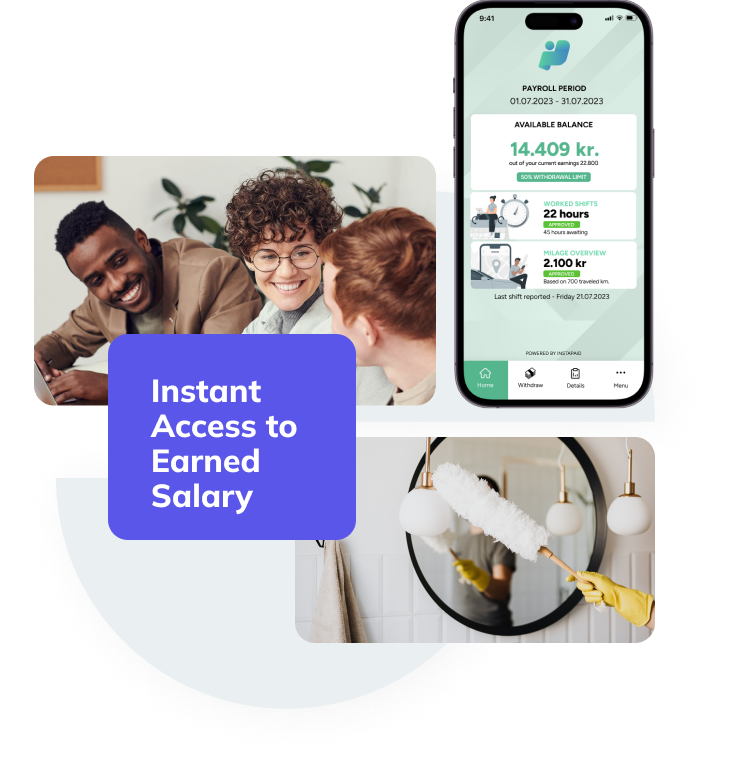
We believe that financial freedom and flexibility in salary payments make a real difference to employee well-being, motivation and loyalty - and ultimately to the company's competitiveness and stability.
Who is InstaPaid?
InstaPaid is a Danish fintech scaleup with a clear mission: to revolutionize how employees get paid. We believe that pay should not be tied to one fixed date per month – instead, employees should be able to access their earned pay as soon as they need it.
Our core values
Freedom & flexibility
With InstaPaid, employees have flexible control over their pay – when they need it. It's about the freedom to respond to life's unpredictability without having to wait for a fixed payday.
Simplicity & integration
InstaPaid is designed as a plug-and-play solution that integrates with payroll systems, time recording systems, and banking – making implementation easy and administration minimal.
Transparency & security
Our platform provides a clear and up-to-date overview of earned wages, shifts and earnings in real time. This creates financial security and trust – both between employee and employer, and internally within the employee.
Employee well-being & accountability
We want to contribute to social sustainability by giving employees real financial flexibility – without loans, interest or complex requirements. InstaPaid is about respecting employees' work and giving them control over their efforts and pay.
Result for employers
For companies, InstaPaid means increased employee satisfaction, higher motivation, lower staff turnover and better utilization of resources – especially in industries with flexible working hours and many hourly employees.
Our vision
We want to revolutionize how employees get their wages paid
Help companies improve employee well-being
Give employees flexible and quick access to earned wages
Minimize the risk of expensive interest when overdrawing your account.
Why now?
The labor market has undergone significant changes as a result of recent macro trends and events. This has led to challenges for many citizens today. At the same time, a completely new generation has emerged on the labor market, which exhibits new work behaviour, has new motives and sets new expectations for future employers.
Employees are increasingly demanding increased flexibility, greater recognition and modernization of salary payments.
With rising costs of living, interest rates, inflation and Generation Z entering the workforce, we see new challenges that employers must meet to remain attractive workplaces.
0%
Younger employees prefer workplaces that offer flexible pay
0%
Employee flight due to financial stress
0%
Feel pressured to cover expenses and pay bills where the due date is before payday
$0
Mia lost in productivity due to financial stress
Sources: JP MORGAN (2022), EY (2020), PWC (2022), HBR (2022), ADP (2022)